
VA Benefits Government Shutdown: What Keeps Running (and What Stops Cold)

It is easy to picture the scene. A student veteran checks a bank account for the third time in an hour, refreshes the VA.gov app, and scrolls through a Reddit thread at 2 a.m. looking for someone who knows what a government shutdown actually means for a GI Bill payment due next week.
Here is the direct answer: VA benefits continue during a government shutdown. Disability compensation deposits arrive on schedule, education payments process normally, and VA medical centers stay open. The core mechanism behind this stability is called advance appropriations, meaning Congress approved this funding years before the current budget fight ever started. According to the Department of Veterans Affairs, roughly 97 percent of VA employees continue working during a shutdown, keeping essential functions running even when the rest of the federal government grinds to a halt.
That is the reassuring part. The harder truth is that a government shutdown creates a strange paradox for veterans: the money keeps flowing, but the help that surrounds it can disappear. The GI Bill hotline goes silent. Regional offices lock their doors. Career counselors and outreach staff get furloughed. Veterans still get paid, but if something goes wrong with a payment or a claim, finding a real person to help sort it out becomes far more difficult. Understanding exactly where that line falls, between what is protected and what is not, is the difference between weathering a shutdown calmly and getting blindsided by it.
.
Why VA Benefits Actually Keep Flowing When the Government Shuts Down
Most veterans assume a government shutdown puts their disability check or education payment at risk. That fear is understandable, but it does not match how VA funding actually works. Unlike many federal agencies that depend entirely on annual appropriations Congress must renew every year, VA’s core benefit programs run on advance appropriations, meaning lawmakers fund them one or more years ahead of time.
This distinction matters enormously during a shutdown. When Congress fails to pass a new budget, the spending authority that expires belongs to programs funded through annual, current-year appropriations. VA’s advance-appropriated programs simply are not part of that fight. The money for this fiscal year’s compensation, pension, and education benefits was already approved in a prior budget cycle and sits in dedicated accounts, insulated from the current impasse.
This protection was not accidental. Congress built it deliberately after earlier funding disputes disrupted veteran services, and it has expanded over time. The VA’s own contingency planning documentation explains that the Veterans Health Administration has received advance appropriations since fiscal year 2013, and the Veterans Benefits Administration has received advance appropriations for its entitlement programs since fiscal year 2017. In other words, lawmakers from both parties built a funding firewall specifically so veterans’ benefits could not become a bargaining chip in a budget standoff.
Think of it like a landlord who is owed rent regardless of what is happening in the news. Congress already handed over the money for VA’s protected programs. A shutdown does not touch it. What a shutdown does touch is everything that depends on this year’s ongoing, annually approved funding: staffing, outreach, call centers, and administrative support. That is where the real disruption lives.
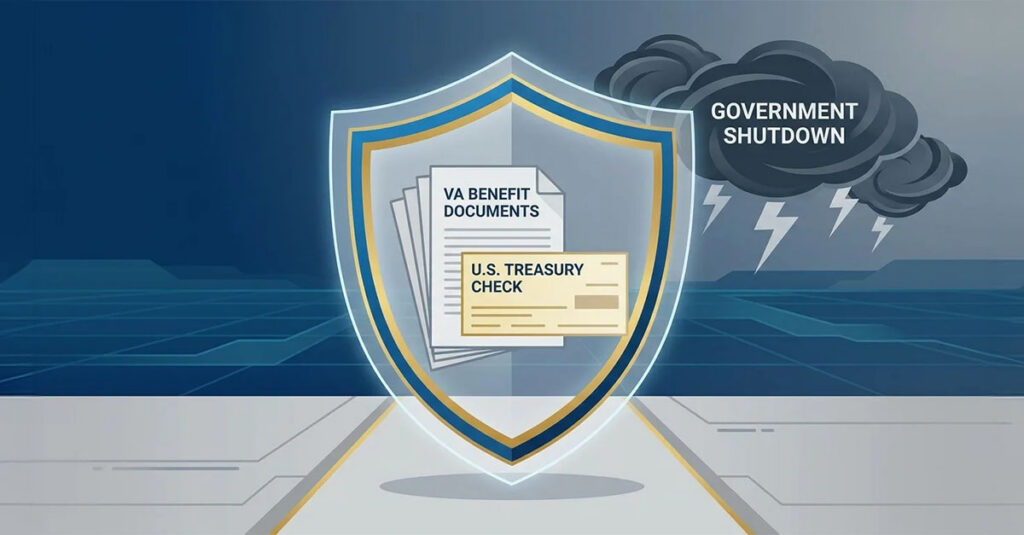
The Advance Appropriations Shield Most People Miss
Advance appropriations refer to budget authority that Congress approves for a fiscal year beyond the current one. When lawmakers pass a bill funding VA’s fiscal year 2026 operations, they do it in a prior year, which means the current year’s funding fight becomes irrelevant to those specific programs. According to VA’s contingency plan, this protection began with the Veterans Health Administration under Public Law 111-81, which authorized VHA to request advance appropriations starting in fiscal year 2011, and VHA has received one every year since fiscal year 2013.
This is different from mandatory spending, like Social Security, which is written into law and does not require annual Congressional action at all. It is also different from ordinary discretionary spending, which needs fresh Congressional approval every single year and is exactly what stops during a shutdown. VA’s advance-appropriated programs occupy a hybrid space: they are technically part of the annual appropriations process, but because Congress funds them a year or more ahead of time, they behave with the stability of mandatory spending once a shutdown hits.
The critical limitation is that only specific programs receive this advance funding. Compensation, pension, education benefits, and core medical care are covered. Many support services, outreach functions, administrative operations, and certain call centers are not, because they are tied to the current year’s regular appropriations. When those lapse, the affected services stop immediately, even while the protected payments keep moving. This is the single most important distinction to understand: money flows from protected accounts that Congress funded long ago, while the infrastructure that helps veterans access, understand, and troubleshoot those benefits often depends on funding that is very much on the table during a shutdown.
.
Which VA Programs Have Protected Funding
VA’s official shutdown guidance is direct about what continues without interruption. Per the VA’s contingency planning page, the following are not impacted by a shutdown:
- Education benefits. Post-9/11 GI Bill monthly housing allowance, tuition payments, book stipends, and fee payments continue processing normally. Montgomery GI Bill monthly payments also continue on schedule.
- Disability compensation. All service-connected disability payments continue regardless of rating, along with Dependency and Indemnity Compensation for survivors and veterans pension payments.
- Healthcare services. VA Medical Centers, Outpatient Clinics, and Vet Centers remain open and provide all services as usual, including scheduled appointments, emergency care, and prescriptions.
- Burial benefits. Burials continue at VA national cemeteries, and applications for headstones, markers, and burial benefits keep processing.
- Appeals processing. The Board of Veterans’ Appeals continues issuing decisions on veterans’ cases.
- Crisis and safety-net services. The Veterans Crisis Line, suicide prevention programs, homelessness services, and caregiver support all remain fully operational.
The critical nuance here is that “continues” means the core function and the payment itself, not every related service that supports it. Education benefits pay out, but as you’ll see in the next section, the hotline that answers questions about them shuts down. Disability checks arrive, but some of the staff who process new or pending claims are furloughed. Healthcare appointments happen, but many of the outreach programs that connect veterans to that care in the first place stop cold. You keep getting your money and your medical care. What you lose, at least temporarily, is a lot of the help navigating the system around it.
.
What Stops the Day a Shutdown Begins
While the previous section outlined what is protected, VA has also been direct about what is not. During the government shutdown that began October 1, 2025 and became the second-longest in U.S. history at 29 days, VA Secretary Doug Collins detailed a specific list of services that stopped. According to a VA press release from that shutdown, impacts included the GI Bill Hotline shutting down for more than 900,000 veterans who rely on it, more than 100,000 enrolled veterans losing access to Veteran Readiness and Employment counseling and case management, 56 VA regional benefits offices closing to the public, and 157 VA national cemeteries no longer performing grounds maintenance or placing permanent headstones.
These are not abstract or theoretical disruptions. They are concrete barriers that block veterans from getting answers, resolving problems, and accessing the human support that often makes benefits usable in the first place. A veteran calls the GI Bill hotline with a question about an enrollment discrepancy, and nobody answers. Another drives to a regional office to submit paperwork, only to find the doors locked. A service member three weeks from separation needs transition assistance that, for the moment, simply does not exist. Education does not pause for a shutdown. Enrollment deadlines still pass, rent is still due, and questions still need answers, even when the people who normally answer them are sent home.

The GI Bill Hotline Goes Dark
The VA Education Call Center, reached at 888-GIBILL-1, is one of the specific functions VA has confirmed will close during a shutdown. Per VA’s Human Capital Contingency Plan, the plan explicitly states that “VA call centers will continue operations, except for the VBA Education Call Center.” The staff who normally field questions about enrollment, certification, and payment amounts are furloughed, and the phone lines stay silent until Congress restores funding.
This creates immediate friction for time-sensitive education issues. A school certification error that is delaying a housing allowance, an automated flag suggesting enrollment might exceed remaining entitlement, or confusion about how a program change affects benefits, all of these typically require a human being to sort out. VA.gov remains accessible throughout a shutdown for transactions that do not require manual intervention, so veterans can still check benefit status, review payment history, and access basic account information. What is missing is the ability to talk through a problem with someone who can look at an individual file and resolve it.
Workarounds exist, but they are limited. A school’s certifying official can often answer questions about enrollment timing, though they cannot resolve VA-side payment or eligibility issues. Campus-based Student Veterans of America chapters provide valuable peer support and shared knowledge from others navigating the same disruption, even though chapter leaders cannot access individual VA records. Online self-service tools help with straightforward questions, but anything outside the standard FAQ template will likely have to wait until the hotline reopens.
.
Career Counseling and VR&E Services Freeze
Veteran Readiness and Employment, sometimes called VR&E or Chapter 31, is one of the programs most visibly affected by a shutdown, though in a way that requires some unpacking. VA’s contingency plan confirms that “Veteran outreach to include Veteran Readiness and Employment … and Personalized Career Planning and Guidance … will be suspended” during a lapse in appropriations. During the 2025 shutdown, VA reported that more than 100,000 enrolled veterans were unable to receive VR&E counseling or case management services, and the backlog of new applicants for the program was growing daily.
The important distinction is between the payment and the service. VR&E subsistence allowances are education benefits funded through advance appropriations, so those payments continue. What stops is the counselor relationship itself: scheduling appointments, adjusting training plans, approving expenses, or helping a veteran pivot when a program is not working out. A veteran already enrolled in an approved training plan that is running smoothly may not notice much disruption in the short term. But a veteran who needs to switch majors, add a course, or resolve a problem requiring a counselor’s sign-off is stuck until the counselor returns from furlough. That gap can matter enormously for someone mid-training who hits an obstacle and has no one to help them navigate it.
.
Transition Assistance Programs Halt
The Transition Assistance Program, known as TAP, is specifically named in VA’s contingency plan as a function that will be suspended during a shutdown. This is particularly hard timing for service members in the narrow window between active duty and civilian life. TAP workshops are designed to prepare separating service members for employment, walk them through benefits, and support financial planning ahead of their transition, and they are built around live facilitation, not just static reading material.
During the 2025 shutdown, VA reported that more than 16,000 service members preparing to leave the military were unable to receive VA transition briefings, because the contract supporting those briefings was not operational during the lapse in appropriations. VA noted that transitioning service members retained online access to the full content of the TAP briefing, but the interactive, personalized guidance that makes the program valuable was not available. Because separation dates are fixed, a shutdown does not create makeup sessions later. It simply consumes a portion of the transition window that cannot be recovered. Service members in this position can still access TAP materials online, connect with Veterans Service Organizations, reach out to employer partners directly, and lean on peer networks of recently separated veterans for guidance while formal programming is paused.
.
How Education Payments Work During a Shutdown
Once the difference between protected payments and vulnerable services is clear, the education benefits picture becomes much less stressful. VA education payments continue processing during a shutdown exactly as they do during normal operations, because they are funded through the same advance appropriations that protect disability compensation. Housing allowance deposits, tuition payments to schools, and book stipends all keep moving on their usual schedule.
The reason this works is automation. Matching enrollment records to entitlement calculations and issuing standard payments does not require the staff who get furloughed during a shutdown. What does require staff is handling exceptions: correcting a certification error, answering an unusual question, or resolving something outside normal parameters. If a payment is late during a shutdown, it is almost always for the same reason a payment would be late any other time, such as a school not yet submitting certification or a certification containing an error, rather than because of the shutdown itself.
This distinction matters because a housing allowance often covers rent, and a landlord does not accept “the government might shut down” as an excuse for a late payment. Knowing that the VA education deposit is on track to arrive on schedule, shutdown or not, provides real financial stability for a student veteran budgeting around a specific date each month.
Monthly Housing Allowances Continue
The Post-9/11 GI Bill monthly housing allowance is one of the payments most explicitly protected during a shutdown. As long as a school has submitted its enrollment certification to VA, the housing allowance processes normally: the calculation is unchanged, based on the Basic Allowance for Housing rate tied to the school’s zip code, prorated for enrollment level and days in class. If a term break means no enrollment, that results in no housing allowance payment, exactly as it would during fully funded operations.
The one variable that can delay a housing allowance during a shutdown is the same variable that can delay it any other time: how quickly the school’s certifying official submits accurate enrollment information. VA’s official guidance confirms that education benefits, including housing benefits, will continue to be processed and delivered during a shutdown. Reddit threads and social media discussions about shutdown-related payment fears often stem from confusion about what a shutdown actually affects. The payment itself is not delayed by a shutdown. What becomes harder is resolving a problem with that payment, since the Education Call Center that would normally help troubleshoot a wrong amount or missed deposit is closed for the duration.
.
Book Stipends and Tuition Reimbursements Process Normally
Every category of education payment tied to advance appropriations continues on its usual schedule. The annual book stipend, tuition payments made directly to schools, and fee payments for costs like technology or lab fees all process through automated systems that do not require the furloughed staff who normally handle exceptions. Schools participating in the Yellow Ribbon Program, which provides additional tuition assistance beyond the standard GI Bill benefit, continue receiving VA’s portion of that funding as well.
Montgomery GI Bill recipients, who receive fixed monthly payments directly rather than through school disbursement, draw from the same advance-appropriated education funding that protects Post-9/11 benefits, so those payments also continue uninterrupted. VR&E subsistence allowances, discussed earlier, follow the same logic: the allowance is a benefit payment funded through protected accounts, while the counseling that surrounds it is a service dependent on annual appropriations. That is why the payment continues even after the counselor delivering the underlying program has been furloughed.
.
The Disability Compensation Reality
Disability compensation may be the single most explicitly protected VA payment during a shutdown, and VA’s own language leaves little ambiguity. According to the VA’s contingency planning page, “VA benefits will continue to be processed and delivered, including compensation, pension, education, and housing benefits,” regardless of shutdown length or the broader political standoff. For many veterans, disability compensation represents a primary or sole source of income, which is exactly why VA and Congress have built such firm protections around it. Payments continue to process through existing systems, direct deposits hit accounts on the usual schedule, and paper checks mail as they normally would.
The distinction that causes the most confusion is between the payment itself and the processing of new or pending claims. An existing disability payment keeps arriving without interruption. A claim that is still working its way through the system, however, can slow considerably, because the staff who review evidence, schedule exams, and issue rating decisions are subject to furlough in a way that finance and payment-processing staff are not.

Why Disability Checks Never Stop
Disability compensation is funded through advance appropriations specifically designed to prevent payment interruptions. Per VA’s contingency plan, the Veterans Benefits Administration has received advance appropriations for its entitlement programs since fiscal year 2017, meaning the money for a given fiscal year’s compensation payments was allocated well before any current shutdown scenario could emerge. The plan also specifically identifies compensation and pension claims processing and payments as functions that will continue during a lapse, because they are “necessarily implied to prevent significant disruption to mandatory benefits programs.”
Direct deposits continue on their standard schedule throughout a shutdown of any length, and veterans receiving paper checks can expect the same timing, since VA’s check-mailing process and postal delivery both continue as independently funded operations. No action is required from veterans to keep these payments flowing. There is no need to call, verify anything, or take any additional steps. The payment arrives because the underlying processing system runs on funding that was never subject to the current budget lapse in the first place.
.
What Happens to Pending Claims
Claims processing works differently from payment continuity, and it is worth understanding the difference clearly. VA designates some claims staff as essential, allowing them to keep working, while others are furloughed, which creates real capacity reductions. New claims can still be filed during a shutdown, whether online through VA.gov, by mail, or with help from a Veterans Service Organization, since intake systems remain operational. What slows down is the actual adjudication work: reviewing evidence, scheduling Compensation and Pension exams, and issuing rating decisions.
VA’s contingency plan notes that the Board of Veterans’ Appeals continues to render decisions during a shutdown, since appeals processing tied to entitlement benefits is considered necessary by implication. However, some of the administrative staff who prepare appeals, schedule hearings, and handle related paperwork may be furloughed, which can create bottlenecks even within functions that are technically protected. If a claim does reach a decision during a shutdown and that decision includes a payment, the payment processes normally, because approved claims convert to payments through the same advance-appropriated funding that protects existing disability compensation. What may be slower is the notification itself, simply because fewer staff are available to generate and send decision letters.
Veterans with a claim in progress during a shutdown should continue checking VA.gov or the VA mobile app for status updates, and it is worth documenting submission dates, exam appointments, and any communications received. Once funding resumes, following up with a regional office or a Veterans Service Organization is a reasonable way to confirm a claim is actively moving again.
.
Healthcare Access During Funding Lapses
VA healthcare is designed to operate with complete continuity during a shutdown. Medical centers stay open, appointments proceed as scheduled, emergency departments remain staffed, and prescriptions continue filling without interruption. This protection flows from the same advance appropriations structure covering other VA benefits, and VA’s contingency plan confirms that “VA Medical Centers, Outpatient Clinics, and Vet Centers will be open as usual and providing all services” throughout a shutdown.
During the 2025 shutdown, VA Secretary Doug Collins reinforced this directly, telling reporters that VA’s health care system was “working” and that veterans seeking care were receiving it without disruption, even as he acknowledged that other parts of the agency’s operations were under strain. The Veterans Health Administration, which represents roughly 90 percent of VA’s overall operations according to that same reporting, is funded through advance appropriations that keep hospitals and clinics running regardless of the broader funding lapse.
This operational continuity extends across the entire VA healthcare system. Outpatient clinics maintain normal schedules, inpatient care continues without disruption, and community care authorizations, which allow veterans to receive care from civilian providers under VA’s payment umbrella, continue processing as well. Veterans relying on VA healthcare do not need a backup plan during a shutdown, because the system supporting their care was never part of the current budget fight.
.
VA Medical Centers Stay Open
All VA medical facilities, from major medical centers to community-based outpatient clinics and specialized treatment facilities, operate at full capacity during a shutdown, because healthcare personnel are designated as essential and continue working. Surgical procedures scheduled during a shutdown proceed as planned, with surgeons, anesthesiologists, and operating room staff continuing their normal duties. Diagnostic services, including imaging, laboratory testing, and specialty consultations across cardiology, oncology, neurology, and other departments, continue on standard timelines.
Inpatient care for hospitalized veterans continues with full nursing coverage and physician support, and emergency departments at VA medical centers remain staffed 24 hours a day throughout any funding lapse. Veterans experiencing a medical emergency should seek care exactly as they would during normal operations, whether that means going to a VA emergency room or calling 911.
Prescription Refills and Appointments Continue
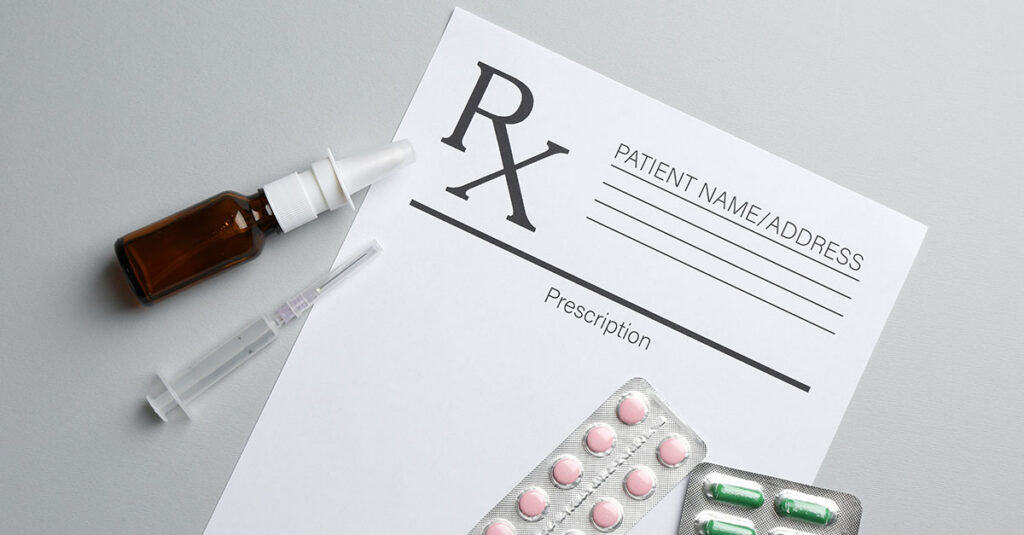
VA pharmacy services continue operating on their regular schedule during a shutdown. Prescription refills process normally, whether picked up at a VA pharmacy or delivered through the mail-order system, and retail pharmacies at VA facilities remain open with full staffing. Community care pharmacy benefits, covering prescriptions filled at civilian pharmacies under a VA care plan, also continue processing without interruption.
Veterans managing chronic conditions that require consistent medication, such as diabetes, high blood pressure, or ongoing mental health treatment, do not need to change their routine because of a shutdown. There is no need to panic-refill early or hoard medication, since the systems supporting pharmacy access are part of the same protected infrastructure covering the rest of VA healthcare.
.
The Hidden Impacts Nobody Warns You About
Payment continuity tends to dominate the headlines during a shutdown, and understandably so. Benefits flow, healthcare stays open, and the immediate financial crisis many veterans fear does not materialize. But beneath that reassuring surface, the broader veteran support ecosystem starts to degrade in ways that compound over time and often persist well after funding resumes. These are not dramatic failures. They are gradual erosions of access, information, and community connection: regional offices lock their doors quietly, outreach events disappear from campus calendars without much notice, and the maintenance crews that keep national cemeteries pristine stop showing up, even as burials themselves continue.
These impacts do not land evenly across the veteran population. Veterans who are comfortable navigating VA.gov, confident working through bureaucracy independently, and connected to a strong peer network may barely notice the disruption. Veterans who rely on in-person help, prefer speaking with a real person for complex questions, or depend on VA outreach events to learn about their benefits in the first place face much steeper barriers. A short-term shutdown can create ripple effects that outlast the shutdown itself, whether that is a veteran who misses an outreach event and never learns about a benefit they were entitled to, or a student who cannot reach a counselor during a critical decision window and makes a choice that shapes their entire education trajectory.
Regional Offices Lock Their Doors
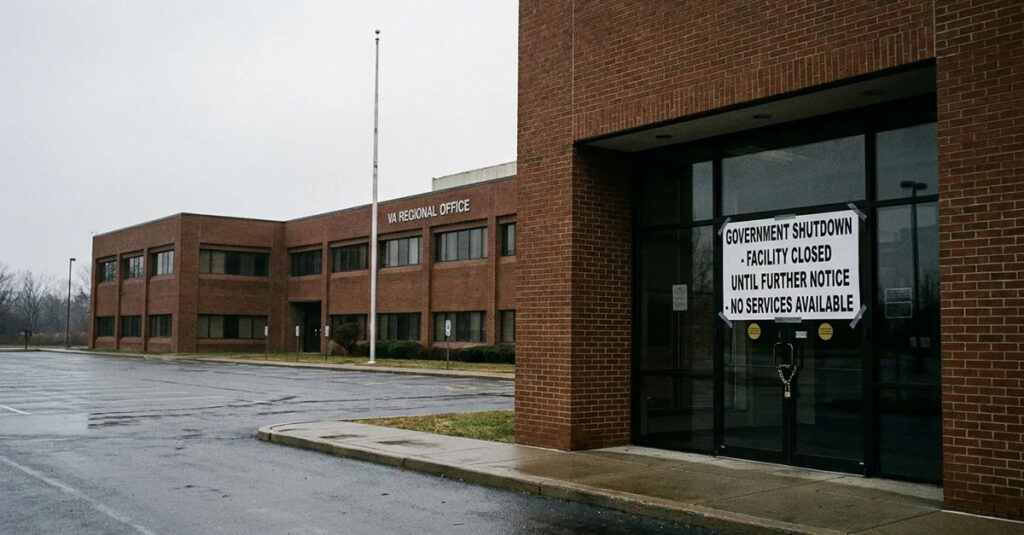
VA regional offices close to the public immediately when a shutdown begins. During the 2025 shutdown, VA confirmed that 56 VA regional benefits offices were closed to the public, and the agency’s Manila regional office closed entirely because its legal authority to operate had expired at the end of the fiscal year. These closures eliminate walk-in access for benefit questions, claims assistance, and document submission for the duration of the shutdown, with no partial reopening or skeleton crew available to handle even urgent matters.
This closure disproportionately affects veterans who rely on in-person help, including those without reliable internet access, veterans for whom navigating VA.gov independently is difficult, and anyone who depends on face-to-face explanation to understand a confusing notice or rating decision. Veterans planning to submit documents in person during a shutdown will need to rely on mail or VA.gov’s electronic upload tools instead, since handing materials directly to regional office staff is simply not possible until offices reopen.
.
Outreach Programs Disappear Overnight
VA’s contingency plan explicitly names outreach as one of the first functions to be suspended during a shutdown, stating that “Veteran outreach through both digital and traditional engagement,” along with outreach to state, county, tribal, municipal, faith-based, and community-based partners, will cease. Community events, campus visits, and benefit information sessions simply do not happen, because the staff who would run them are furloughed.
This matters most for veterans who discover benefits through outreach rather than independent research. Many veterans first learn about education benefits, healthcare eligibility, or disability compensation options because a VA representative visited their campus, spoke at a community event, or conducted an information session at a local gathering. When outreach stops, that discovery pathway disappears for the duration of the shutdown, and it does not get made up afterward. An information session scheduled for the third week of a shutdown simply does not happen, and the veterans who would have attended never receive that information through that channel. Rural veterans and those in underserved communities, for whom outreach programs sometimes represent the only regular VA presence nearby, can feel this loss most acutely.
For student veterans specifically, this is where campus community becomes especially valuable. When VA’s own outreach machinery pauses, connecting with your local SVA chapter for peer support and shared information can help fill some of that gap, since chapter members are often the first to hear about workarounds, timing, and practical next steps from others navigating the same disruption.
.
Cemetery Grounds Maintenance Stops
National cemetery grounds maintenance stops during a shutdown, even while burial services themselves continue. VA’s contingency plan is specific on this point, stating that “permanent headstone or marker installation by NCA employees; grounds maintenance (mowing, trimming, mulching or other landscape management); processing of new Presidential Memorial Certificates … and awarding of new grants” as part of the Veterans Cemetery Grant Program will all cease. During the 2025 shutdown, VA confirmed that 157 VA national cemeteries across the country were no longer performing grounds maintenance or placing permanent headstones.
Burials continue because the National Cemetery Administration’s core function of interring veterans and determining eligibility is protected to safeguard human life and dignity, and burial teams and honor guards remain on duty. What pauses is the routine upkeep between burials and the installation of permanent headstones, meaning families may see temporary markers in place for longer than usual while they wait for a permanent one, tied to when funding resumes and staff return from furlough.
.
VA Employee Furloughs and What They Mean for You
Every government shutdown forces VA to divide its workforce into two categories: those whose work continues, and those who are furloughed and legally prohibited from working at all, even voluntarily. This division is what creates the gap between the benefits that keep flowing and the services that disappear. Per VA’s Human Capital Contingency Plan, the department’s current projection is that 97 percent of VA employees, roughly 446,625 people, would be fully funded or performing excepted functions during a shutdown, out of a total workforce of 461,499. That leaves approximately 14,874 employees who would be furloughed entirely.
During the actual 2025 shutdown, VA reported that nearly 37,000 employees were furloughed or continued working without pay, a larger figure than the baseline projection, reflecting how a real, extended shutdown can affect staffing beyond initial estimates. Even among employees whose functions continue, capacity can shrink when the administrative staff who support them, such as those who organize files or manage scheduling, are furloughed. This is why even protected functions can slow down somewhat during an extended lapse, even though the core payments and services they support remain intact.

Who Gets Sent Home
Healthcare workers, including doctors, nurses, pharmacists, and mental health counselors, remain on duty throughout a shutdown as essential personnel, since the Veterans Health Administration is fully funded through advance appropriations. Benefits payment processors, including the staff calculating education payments and processing disability compensation, also continue working, because stopping those payments would directly harm veterans who depend on them.
Claims adjudicators fall into a mixed category. VA’s contingency plan designates 14,971 VBA staff as excepted because they perform claims processing work necessarily implied by law to protect mandatory benefits programs, while other administrative and support staff within the same agency are furloughed. This mixed designation is part of why claims processing continues but often slows during a shutdown, even though it is technically a protected function.
Call center staff for the Education Call Center are furloughed entirely, per VA’s explicit exception in its contingency plan, while VA’s primary call centers, including MyVA411 and the Veterans Crisis Line, remain staffed to protect life and prevent disruption to benefit programs. VR&E counselors and outreach coordinators are also furloughed, since counseling and outreach functions are not funded through advance appropriations, even though the subsistence allowances those counselors help administer continue because they are benefit payments.
.
How Staffing Gaps Slow Everything Down
When fewer staff are available to handle the same volume of incoming work, backlogs build quickly. A regional office that might normally decide a certain number of claims each day can see that capacity drop significantly during a shutdown, even as new claims continue arriving at the usual rate. This mismatch between steady incoming demand and reduced processing capacity is precisely why claims and appeals timelines tend to extend well beyond the shutdown period itself.
Recovery from this kind of backlog typically takes longer than the shutdown that created it, since returning employees must work through accumulated cases while new work continues to arrive at the same time. Veterans filing claims or seeking services in the weeks immediately following a shutdown may still experience some degraded service, even after funding has been fully restored, simply because the system needs time to catch back up.
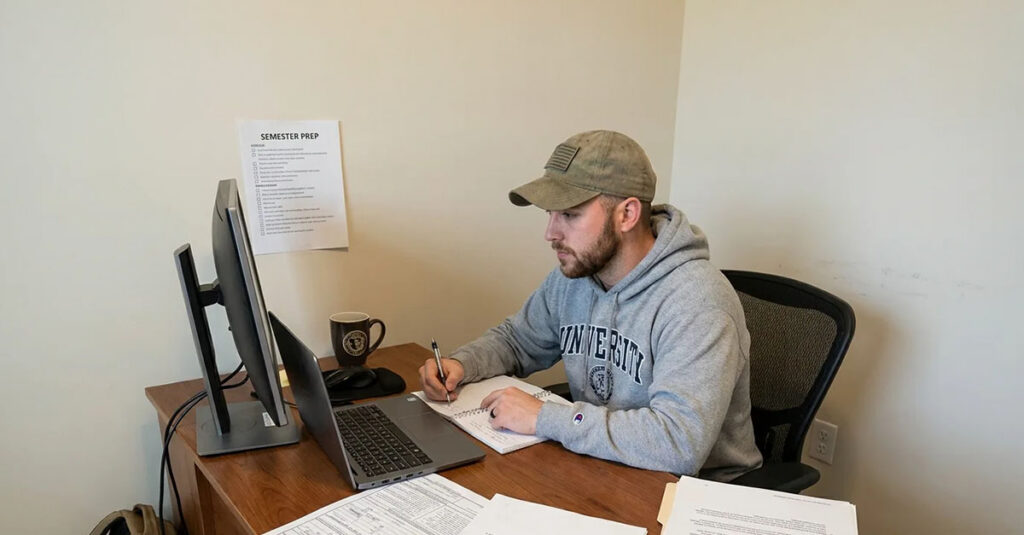
What Student Veterans Should Do Right Now
Preparation matters more than panic. Nothing here can prevent a shutdown, but a handful of practical steps, most of which take only a few minutes, can meaningfully reduce the impact on your education, your benefits, and your peace of mind. The goal is not to prepare for benefits disappearing, since they will not, but to prepare for the support infrastructure around those benefits to temporarily go quiet.
- Check your VA.gov payment history. Confirm your typical deposit dates and amounts so you can immediately recognize whether something is genuinely wrong versus simply on its normal schedule.
- Verify your direct deposit information. Outdated bank details cause more payment problems than shutdowns ever will, so confirm your routing and account numbers are current before any disruption hits.
- Download your Certificate of Eligibility and award letters. Having proof of your benefit entitlement and payment amounts on hand, independent of VA website access, is useful if you ever need to demonstrate eligibility to a school, landlord, or creditor.
- Screenshot your eBenefits and VA.gov account information. Capture your enrollment status, benefit usage, remaining entitlement, and any pending claim details, so you have a local record if VA systems become slow or hard to reach.
- Connect with your school’s certifying official ahead of time. Introduce yourself, confirm they have accurate enrollment information on file, and save their contact details. During a shutdown, they become one of your most useful resources for certification questions, even though they cannot resolve VA-side payment issues.
- Bookmark VA.gov’s self-service tools. Know how to check benefit status, view payment history, and access letters before you actually need to do it under pressure.
- Join your campus SVA chapter. Peer support becomes especially valuable when federal resources go quiet. You can find your nearest SVA chapter to connect with other student veterans navigating the same challenges.
- Document any pending claims. Write down submission dates, exam appointments, and any communications you receive, so you have your own record if VA systems slow down.
If a shutdown does hit, resist the urge to repeatedly call or email an already-overwhelmed system. Lean on self-service tools first, reach out to your school’s certifying official for certification questions, and stay connected to your campus veteran community for real-time, practical information. Other student veterans facing the same situation often share workarounds and updates faster than official channels can, simply because they are living through it alongside you. Above all, remember the core distinction that runs through everything in this piece: your money is safe, and your health care is safe. What may be temporarily unavailable is quick access to help if something outside the ordinary comes up.
.
Frequently Asked Questions
Will my Post-9/11 GI Bill housing allowance still be deposited if the government shuts down?
Yes. The Post-9/11 GI Bill monthly housing allowance continues processing on schedule during a shutdown, because it is funded through advance appropriations that Congress approved in a prior budget cycle. As long as your school has submitted your enrollment certification, your payment will process normally. Per VA’s own guidance, education and housing benefits are explicitly listed among the functions that continue uninterrupted.
Can I still call the GI Bill hotline if I have questions about my benefits?
No. The VA Education Call Center (888-GIBILL-1) is specifically named in VA’s contingency plan as a function that will cease during a shutdown, since the staff who answer it are furloughed. Alternatives include your school’s certifying official for enrollment questions, VA.gov’s self-service tools for checking benefit status, and your campus SVA chapter for peer support and shared information.
Does a government shutdown delay disability compensation payments?
No. Disability compensation continues processing on its normal schedule regardless of shutdown length, because it is funded through advance appropriations specifically designed to prevent payment interruptions. What can slow down is the processing of new or pending claims, since some claims staff are furloughed, but existing payments are not affected.
What happens to my VA healthcare appointments during a shutdown?
They proceed as scheduled. VA Medical Centers, Outpatient Clinics, and Vet Centers remain open and continue providing all services, including scheduled appointments, surgeries, diagnostic testing, and emergency care. VA Secretary Doug Collins reinforced this during the 2025 shutdown, stating that VA’s health care system continued operating normally even as other parts of the agency’s operations were strained.
Will VA regional offices be open if I need to visit in person?
No. VA benefits regional offices close to the public during a shutdown. During the 2025 shutdown, 56 regional offices closed, and there is no partial reopening or reduced-hours option. Alternatives during this period include submitting documents by mail, using VA.gov’s electronic upload tools where available, and working with a Veterans Service Organization for claims assistance.
.
Final Thoughts
A government shutdown creates a strange paradox for veterans. Money arrives, healthcare continues, and education benefits process normally, all while the infrastructure built to help you understand and use those benefits can go quiet at the exact moment you might need it most. This is not a flaw in VA’s shutdown planning. It is the plan working exactly as designed: protect the money, and let everything else become negotiable within legal limits.
For student veterans, this timing can be especially difficult, since education does not pause for a budget standoff. Enrollment deadlines still pass, housing payments are still due, and academic questions still need answers now. But it is worth holding onto what is genuinely solid here: Congress structured VA’s core funding deliberately so that disability compensation, education payments, and healthcare access continue regardless of political dysfunction in Washington. That floor holds, shutdown after shutdown.
What does not hold as firmly is quick access to help when something unusual comes up, whether that is a certification error, a payment that looks off, or a question that does not fit the standard FAQ. The best defense is preparation done ahead of time: document your information, know your school’s certifying official, and build your own support network before you need it. Student Veterans of America exists in part for moments like these, when campus chapters and veteran communities can fill the gap that federal outreach leaves behind. You are not the only one checking your bank account twice and refreshing VA.gov. Connect with other student veterans, share what you know, and help each other work through the bureaucracy while the hotline is quiet. Your benefits will arrive. Just do not expect anyone to pick up the phone right away if you call to ask why.
.