
How to Apply for VA Benefits: A Guide to Disability, Education, Health Care, and More

Getting your claim approved should not feel like cracking a code, but the application process can hide requirements that are easy to miss. This guide covers how to apply across the full range of VA benefits, including disability compensation, health care, home loans, and survivor benefits, with particular attention to education benefits like the GI Bill, since that is where most student veterans start. You have probably filled out forms before, but when you sit down to apply for any of these VA benefits, you may run into dependencies and details that standard instructions do not fully explain. The Department of Veterans Affairs offers several ways to apply for benefits depending on the type of benefit you are seeking, and VA encourages working with an accredited representative who can assist with the claims process.
.
Why Application Readiness Matters More Than the Forms Themselves
Most veterans treat the application itself as the hard part, when in practice it is usually the easiest step once the groundwork is done. VA reviewers look for specific documentation and evidence, and missing even one piece often means a request for more information, which adds time back onto your claim.
Readiness means confirming your discharge characterization, identifying which benefits actually apply to your situation, and gathering service records, medical documentation, and supporting statements before you open the application. Some benefits also depend on others being approved first. For example, Veteran Readiness and Employment services generally require that your service-connected disability already limits your ability to work before VA can help you access training or education support tied to that program.
Application instructions generally assume you already know your eligibility category and have your evidence organized. They do not walk you through how to determine those things in the first place, which means most of the real work happens before you type your first answer.
Application Readiness Checklist:
- Obtain a certified copy of your DD214, or DD215 if corrections were made
- Request service treatment records if you do not already have copies
- Confirm your discharge characterization meets the requirements for the benefit you are pursuing
- Identify every condition or benefit you intend to claim
- Gather current medical records and diagnosis documentation
- Collect evidence connecting service events to your current condition
- Verify dependent status with marriage certificates, birth certificates, or school enrollment records
- Determine whether any benefit you are claiming has a prerequisite approval
- Keep copies of everything before you submit
- Note any deadlines or time-sensitive windows tied to your specific benefit
.
Who Qualifies to Apply for Veterans Benefits
Eligibility is not a single standard. It shifts depending on which benefit you are applying for, and the differences matter more than most veterans expect.
For VA disability compensation, eligibility does not depend on a minimum length of service. You need a current diagnosed condition and evidence connecting it to your time in service, whether that connection is direct, a condition that was aggravated by service, or a condition that developed after service but was caused by something already service-connected.
VA health care works differently. If you enlisted after September 7, 1980, or entered active duty after October 16, 1981, you generally need 24 continuous months of active duty, or the full period you were called to serve, unless you were discharged for a service-connected disability, a hardship, or an early out. Reserve and National Guard members generally need to have been called to active duty by federal order and to have completed that full period. Time spent on active duty for training purposes only does not typically qualify you on its own.
The Post-9/11 GI Bill requires at least 90 days of active duty on or after September 11, 2001, or a Purple Heart earned on or after that date, along with an honorable discharge for that qualifying period, according to VA’s eligibility page.
Veterans Pension works on a different track entirely. According to VA’s pension eligibility page, you generally need at least 90 days of active duty with at least one day during a recognized wartime period if you served before September 8, 1980, or 24 months of active duty with the same wartime requirement if you enlisted after that date. You also need to meet income and net worth limits set by Congress, and you need to be at least 65 years old, have a permanent and total disability, or meet certain other conditions.
VA home loan eligibility depends heavily on when and how you served. Active service members generally qualify after 90 continuous days of service, while veterans face different minimum requirements depending on their service era, and National Guard and Reserve members generally need either specific qualifying active duty periods or six creditable years of service.
Discharge characterization affects all of these categories. If you received an other than honorable, bad conduct, or dishonorable discharge, VA’s guidance notes you may still be able to qualify by applying for a discharge upgrade or requesting a VA Character of Discharge review.
.
| Benefit Type | Minimum Service Requirement | Discharge Status Generally Required |
| Disability Compensation | No minimum, but must show condition connects to service | Not dishonorable |
| VA Health Care | 24 months active duty or full period called or ordered, with exceptions | Not dishonorable |
| Post-9/11 GI Bill | 90 days active duty after September 10, 2001, or qualifying Purple Heart | Honorable for qualifying period |
| VA Pension | 90 days active duty with 1 day during wartime (pre-1980), or 24 months (post-1980) | Not dishonorable |
| VA Home Loan | Varies by era; 90 continuous days for current service members | Not dishonorable |
Choosing the Right Application Method for Your Situation
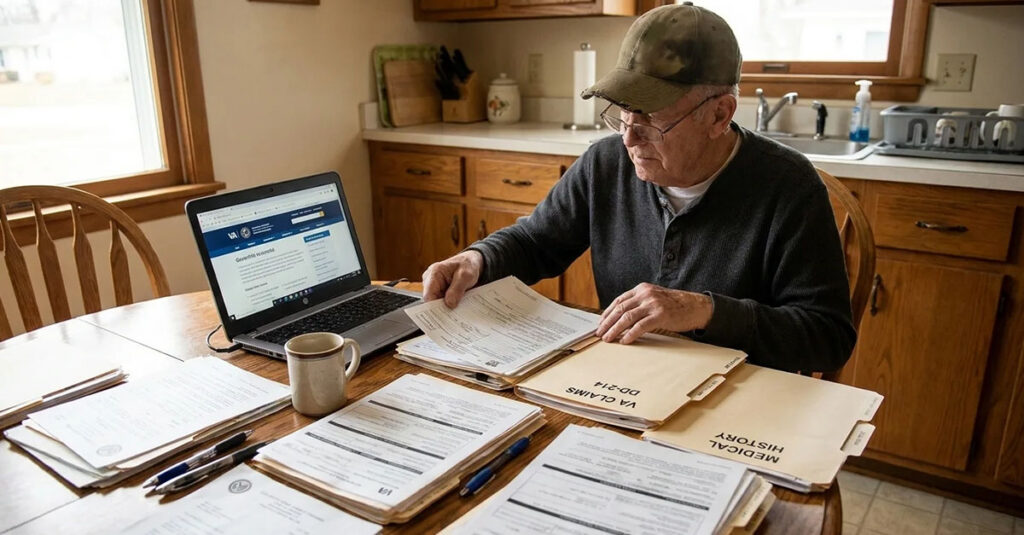
VA.gov is generally the fastest way to apply for most benefits, since it offers real-time validation and saves your progress automatically. Not every benefit type has a fully built-out online application, so mailing a paper form still makes sense in some cases, particularly when you need to attach extensive documentation.
Applying in person at a VA regional office, or with help from a Veterans Service Organization representative, is worth considering if your situation is complex, you want help interpreting the questions, or you would like a trained advocate to review your application before you submit it.
VA has also expanded mobile access in recent years. According to VA.gov, veterans can manage several aspects of their benefits directly through the VA Health and Benefits App, including refilling prescriptions, messaging their care team, and checking benefit status from a smartphone.
If you start an application online and later need to mail in supporting documents, keep your application confirmation number so VA can match the documents to the right file. The method you choose affects how easily you can track your claim’s progress, so it is worth matching the channel to the benefit type and your own comfort with digital systems.
.
Required Documents VA Does Not Always Spell Out Upfront
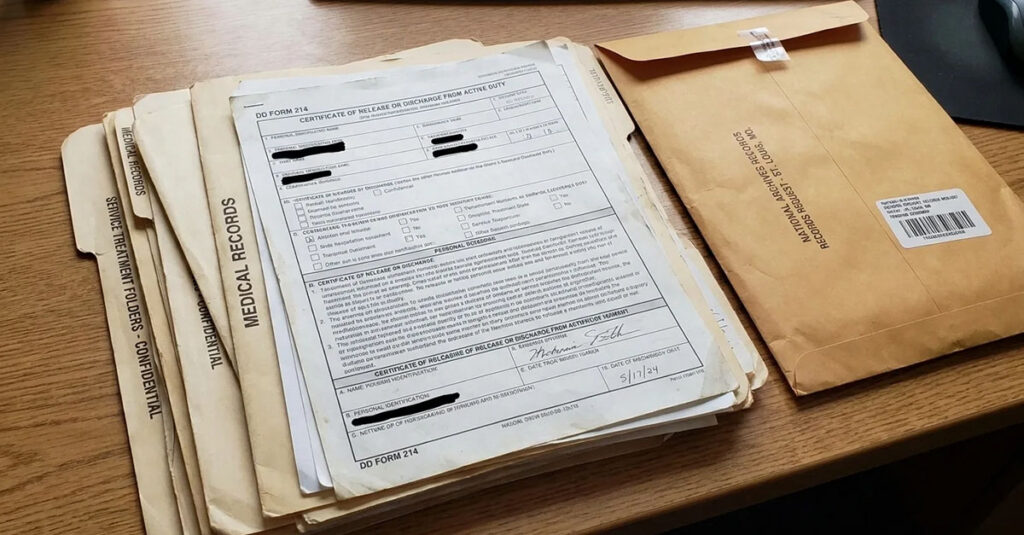
The application form asks for basic information, but approval usually depends on the evidence you attach or that VA can access on your behalf. Service records come first: your DD214, or DD215 if corrections were made, along with service treatment records and personnel files if you do not already have copies.
According to the National Archives, many health records were lent to the Department of Veterans Affairs prior to the 1973 fire at the National Personnel Records Center, and veterans who have filed a medical claim in the past should check with VA to see if their record is already on file there before requesting a new copy elsewhere.
Medical evidence includes VA medical records if you have been treated at VA facilities, private treatment records, and statements from a doctor connecting your condition to your service. According to VA’s guidance on filing a disability claim, you can also submit supporting statements from family members, friends, clergy, law enforcement personnel, or people you served with, which can help explain your claimed condition and how or when it developed.
Dependency documentation includes marriage certificates, birth certificates for children, school enrollment proof for education benefits, and divorce decrees where applicable, since VA needs this information to confirm who qualifies as your dependent. For needs-based benefits like pension, you will also need income statements, documentation of assets, and records of unreimbursed medical expenses.
VA can request some records on your behalf, but that process can add time to your claim. Having these documents ready before you apply generally speeds things up considerably.
How to Apply for VA Disability Benefits Without Leaving Evidence Gaps
Understanding Service Connection Before You File
A successful disability claim generally rests on three elements: a current diagnosed condition, an in-service event or injury, and evidence linking the two together, sometimes called a medical nexus. Many veterans file with a diagnosis but without clear evidence tying it back to their service, or they can describe the in-service event clearly but lack current medical documentation of the condition itself.
You can also file for a condition that developed after service if you can show it was caused by a condition that is already service-connected, sometimes called secondary service connection. For certain conditions, VA automatically presumes service caused the condition if you meet specific service requirements, including chronic illnesses that appear within one year of discharge, illnesses linked to contact with toxic substances, and conditions connected to time as a prisoner of war. Even with a presumptive condition, you still need to show that you meet the underlying service requirements tied to that presumption.
Completing the Disability Claim Application
You can file a disability claim online, by mail using VA Form 21-526EZ, in person at a VA regional office, by fax, or with help from an accredited representative. When listing your conditions, be as specific as you can, and provide your best estimate of dates even if you cannot remember them exactly, along with an explanation if you believe records might be incomplete.
According to VA’s own guidance, you do not have to submit evidence with your claim at all. VA may schedule a Compensation and Pension exam to learn more about your condition instead. That said, submitting supporting records upfront when you have them tends to help your claim move faster.
If you plan to file using a paper form, VA recommends submitting an intent to file first, which can preserve an earlier effective date while you gather your evidence. If you file online instead, you generally do not need a separate intent to file, since VA sets your effective date automatically once you begin filling out the online form, even before you submit it.
Submitting Evidence and Following Up
Upload documents directly through VA.gov when you can, and keep copies of everything you submit. If you are mailing evidence instead, VA’s current mailing address for disability claims is Department of Veterans Affairs, Claims Intake Center, PO Box 4444, Janesville, WI 53547-4444, and it is worth referencing your claim number on every page you send.
If VA schedules a Compensation and Pension exam, attend it and answer questions honestly, including describing how your condition affects you on a difficult day, not just a good one. You can check your claim status on VA.gov, and it is worth knowing that VA’s processing times have improved substantially in recent periods. According to VA’s own claims tracker, the average time to complete a disability-related claim was 68.4 days as of August 2026, a significant improvement from prior years, though individual claims can still take longer depending on complexity, the need for exams, or requests for additional evidence.
If VA sends a development letter asking for more evidence, responding quickly with exactly what was requested helps keep your claim moving. You can also submit additional evidence at any point before a decision is made if you discover something relevant.
If you would rather work through your claim face to face, VA disability claims professionals are typically on site at Student Veterans of America’s National Conference, where they have provided benefits counseling, scheduled Compensation and Pension exams, and completed disability ratings for student veterans in past years. The 19th Annual NatCon runs January 4 through 6, 2027, at the Gaylord Texan Resort and Convention Center in Grapevine, Texas, and is worth considering if you want hands-on help with a pending or upcoming claim.
Applying for VA Health Care When You Are Not Service-Connected
You do not need a service-connected disability rating to enroll in VA health care. According to VA’s eligibility guidance, eligibility depends on a combination of factors, including your discharge status, length of service, income, and other circumstances such as toxic exposure during service.
Once you are enrolled, VA assigns you to one of eight priority groups, which affects how much, if anything, you will pay toward the cost of your care. According to VA’s priority group guidance, veterans with service-connected disabilities generally receive the highest priority, while veterans with higher incomes and no service-connected disabilities generally receive the lowest.
.
| Priority Group | General Basis for Assignment |
| Group 1 | Service-connected disability rated 50% or higher, or found unemployable due to service-connected disability, or Medal of Honor recipient |
| Group 2 | Service-connected disability rated 30% or 40% |
| Group 3 | Former POW, Purple Heart recipient, discharged for a service-connected disability, or service-connected disability rated 10% or 20% |
| Group 4 | Receiving VA aid and attendance or housebound benefits, or determined catastrophically disabled |
| Group 5 | No service-connected disability or a 0% non-compensable rating, with income below VA limits, or receiving VA pension or Medicaid |
| Group 6 | Compensable 0% service-connected disability, certain toxic exposure circumstances, or combat service in specific periods |
| Group 7 | Income below geographically adjusted limits, agrees to pay copays |
| Group 8 | Income above VA limits, agrees to pay copays |
If you served in a combat zone after November 11, 1998, and were discharged on or after September 11, 2001, VA generally provides 10 years of enhanced eligibility from your discharge date, placing you in priority group 6 during that window regardless of whether you have a diagnosed condition yet.
You can enroll in VA health care using VA Form 10-10EZ, available online, by mail, or in person at any VA medical center. The form asks for demographic information, military service details, and financial information, and providing your financial information is what allows VA to determine your exact priority group and copay level.
Education Benefits Applications and the Timing Problem
Choosing between GI Bill programs depends on your specific service history. The Post-9/11 GI Bill generally offers the most support, covering tuition, a housing allowance, and a book stipend for veterans who meet the 90-day active duty threshold. Montgomery GI Bill Active Duty requires that you contributed to the program during service and pays a fixed monthly amount rather than covering tuition directly. Veteran Readiness and Employment, sometimes called Chapter 31, is a separate program for veterans with service-connected disabilities who need training or education to support returning to work, and it requires its own separate rating and approval process.
You generally cannot use more than one education benefit for the same enrollment period, and in some cases, switching from one program to another means giving up your remaining entitlement under the original program, so it is worth thinking through which program fits your full education plan before committing.
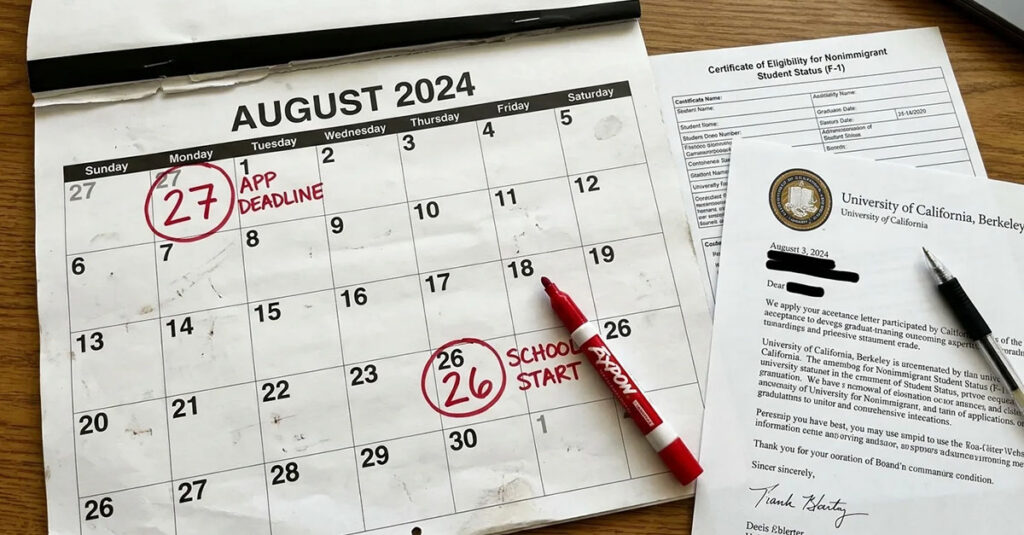
Once you apply and are approved, you will receive a Certificate of Eligibility to provide to your school. Timing matters considerably here. Applying well before your term starts gives VA time to verify your enrollment with the school before benefits are paid, which can affect whether your housing allowance arrives on schedule. Your school must also be approved for VA benefits and must certify your enrollment after you register, since VA cannot pay benefits for coursework a school does not report.
After your first application, you typically do not need to reapply every term, but your enrollment still needs to be verified whenever it changes. Dropping classes after your school has already certified your enrollment can create an overpayment that you will be responsible for repaying, since your housing allowance is calculated based on your enrollment level.
.
Home Loan Certificate Requests and What Lenders Actually Need
VA does not lend money directly. Instead, it guarantees a portion of your loan, which allows private lenders to offer more favorable terms, often including no down payment requirement. To use this benefit, you need a Certificate of Eligibility, which you can request online through VA.gov, through your lender, or by mailing VA Form 26-1880.
Eligibility depends on your service era and length of service. Current service members generally qualify after 90 continuous days of active duty. Veterans face different requirements depending on when they served, generally either 24 continuous months of active duty or the full period they were called to serve, with exceptions for those discharged for a service-connected disability, hardship, or other qualifying circumstances. National Guard and Reserve members generally need either specific qualifying active duty service or six creditable years of service.
If you have used your entitlement before, you may be able to restore it, for example if you sold the home purchased with a prior VA loan and paid off that loan in full. Your Certificate of Eligibility shows your available entitlement amount, which affects the loan size VA will guarantee, though you can still purchase a more expensive home if you are prepared to cover the difference with a down payment. The certificate proves your eligibility, but you will still need to qualify financially with your lender based on income, credit, and debt-to-income ratio.
.
Pension and Survivor Benefit Applications for Family Members
Veterans Pension for Wartime Service
Veterans Pension provides a monthly payment for wartime veterans who meet certain age or disability requirements and whose income and net worth fall within limits set by Congress. According to VA’s pension eligibility guidance, you need to be at least 65 years old, have a permanent and total disability, be a nursing home patient due to a disability, or be receiving Social Security Disability Insurance or Supplemental Security Income, in addition to meeting the wartime service requirement.
You can apply using VA Form 21P-527EZ online, by mail, in person, or with help from an accredited representative. The application requires detailed financial disclosure along with documentation of your marriage and any dependents.
Dependency and Indemnity Compensation for Survivors
Dependency and Indemnity Compensation, or DIC, is a tax-free monthly benefit for eligible survivors of a service member who died on active duty or from a service-connected condition. According to VA’s DIC guidance, surviving spouses generally need to have been married to the veteran at the time of death, and remarriage can affect eligibility depending on when it occurred. If you remarried on or after December 16, 2003, you generally needed to be 57 or older at the time to remain eligible. If you remarried on or after January 5, 2021, that age threshold drops to 55. Children under 18, or under 23 if enrolled in a VA-approved school program, may also qualify, along with certain adult children who are permanently unable to support themselves due to a disability that began before age 18.
The application requires marriage and birth certificates, the veteran’s DD214, a death certificate, and evidence establishing the service connection of the death.
What Happens After You Submit and How to Track It
Processing times vary considerably by benefit type. VA’s most recent published figures show significant improvement for disability claims specifically. According to VA’s press room, the average time to complete a disability compensation decision fell to 78.6 days by the end of May 2026, down from 141.5 days in January 2025. VA’s live tracker later showed an average of 68.4 days as of August 2026, though these figures represent averages across all claims, and individual cases can move faster or slower depending on complexity.
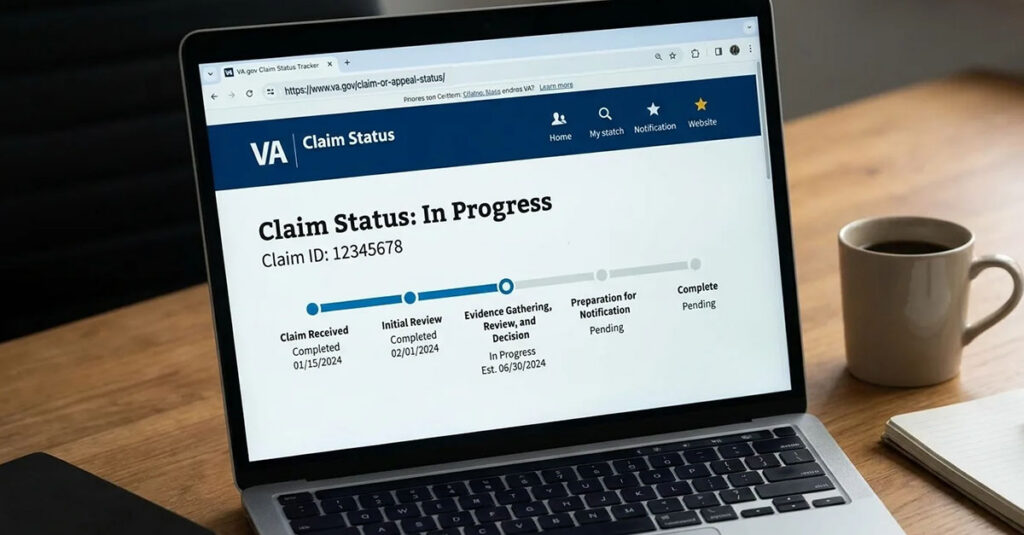
You can track most claims through VA.gov under the claims status section, which shows your claim’s current phase. This tracker does not always update the moment something changes behind the scenes, so it is worth checking your mail and email regularly in case VA needs additional information or wants to schedule an exam.
Decisions typically arrive by mail, and the letter explains what was approved, denied, or deferred pending more evidence. Approved benefits generally carry an effective date based on when you filed or when you became eligible, whichever is later, and back pay is calculated from that date. If your claim is denied, you generally have options to appeal or submit new evidence, and the decision letter will explain the specific paths available to you.
.
Common Application Errors That Delay or Deny Claims
A handful of avoidable mistakes account for a large share of delays. Leaving fields blank that VA considers mandatory, even if they seem optional, often triggers a request for more information rather than an outright denial, but it still adds time. Using vague descriptions of a condition instead of specific medical terminology can also slow things down, as can providing dates or details that are inconsistent across different forms and documents.
Failing to list every condition or every relevant in-service event upfront, then trying to add them later, can restart part of VA’s review process for that portion of your claim. Missing evidence does not always trigger a helpful request for more information. Sometimes it results in a denial that you then have to appeal with the evidence you should have included the first time.
Submitting a claim without any medical evidence of a current diagnosis, or with records that describe a diagnosis but do not connect it to your service, both create the same underlying problem: VA cannot establish the nexus it needs to approve the claim. Uploading illegible documents, or files that VA’s system cannot open, creates its own delay even when the underlying evidence would have supported your claim.
Filing under the wrong benefit category is another common issue. Applying for pension when disability compensation is the better fit, or the reverse, can add unnecessary time to your claim, since VA needs to determine the right category before it can move forward. Confirming your program and school are VA-approved before applying for education benefits, and choosing the correct application type when you already have a prior decision on file, both help avoid preventable delays.
When to Get Help and Where Student Veterans of America Fits
You can file on your own, and many veterans do so successfully, but complex claims involving multiple conditions, missing records, or a prior denial often benefit from a second set of eyes. Veterans Service Organizations employ accredited representatives who can review your claim, help you gather evidence, and represent you at no cost. Major organizations include the American Legion, the VFW, and Disabled American Veterans, among others. Accredited attorneys and claims agents can also help, though they generally charge fees tied to any back pay awarded if an appeal succeeds.
If you are a student veteran, applying for benefits often means juggling additional timing considerations, including how your GI Bill benefits interact with a disability claim in progress, or how school certification delays might affect your housing allowance. Student Veterans of America provides comprehensive support for veterans navigating higher education, and its network of active campus chapters can connect you with peers who have already been through the application process and can point you toward the right resources.
SVA does not replace a VSO or an attorney, but it fills a real gap for many student veterans: practical guidance from people who understand both the VA system and the demands of college life at the same time. SVA’s programs and events connect student veterans with resources and opportunities across its national network.
.
Final Thoughts
The application itself is rarely the hardest part of getting the benefits you have earned. Gathering the right evidence, understanding what VA actually needs to see, and timing your application correctly all matter more than the form-filling step at the end. You have earned these benefits through your service, but the process still requires you to document your eligibility and connect the pieces of your service history to your current situation clearly.
Mistakes and delays are common, but most are avoidable if you approach the application as a documentation project rather than something to rush through. It is worth starting the process as soon as you know you will need a benefit, whether that is before you start school, before you apply for a home loan, or as soon as a condition develops, rather than waiting until you are in a difficult spot.
If your first application is denied, that is not necessarily the end of the road. Appeals and supplemental claims with stronger evidence succeed regularly. Making use of the resources available to you, including VSOs, your school’s certifying official, and Student Veterans of America, means you do not have to navigate this process alone. Student Veterans of America stands ready to support you throughout your educational journey and the benefits process that comes with it.
.